

Accountability after Economic Crisis Retribution, Truth, or Acknowledgment?
, by Kovras, Iosif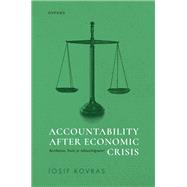
- ISBN: 9780198942771 | 019894277X
- Cover: Hardcover
- Copyright: 6/13/2025
Accountability after Economic Crisis reconstructs the captivating story of how different nations responded to the 2008 economic crisis, one of the most challenging economic downturns in modern history. The book focuses on puzzling cross-country variations in policies of accountability. Why did some countries look for explanations of the economic failure and seek to hold those responsible to account, while others looked the other way? And among those countries looking for the truth, were some more successful than others? If so, were certain methods more effective than others? Is there, in fact, a best way?
Iosif Kovras introduces an innovative framework to explain the varied political responses to an economic crisis, pushing the boundaries of traditional analysis by drawing on political economy, comparative politics, public administration, economic history, criminal law, and criminology. To test this framework, he draws on five post-2008 case studies, Ireland, Iceland, Greece, and Cyprus, and adds the experience of the United States in the Great Depression to refine the framework. He identifies three distinct accountability mechanisms used by leaders: retribution - prosecuting those at fault; truth recovery - establishing commissions of inquiry to reveal the facts; official acknowledgment - issuing formal apologies. Zeroing in on each country in turn, he shows how these mechanisms were employed and with what effect.
Featuring original observations from a survey in Iceland and experimental data from a conjoint experiment, Accountability after Economic Crisis provides a thorough and engaging examination of how countries manage accountability in the wake of an economic crisis.
Iosif Kovras introduces an innovative framework to explain the varied political responses to an economic crisis, pushing the boundaries of traditional analysis by drawing on political economy, comparative politics, public administration, economic history, criminal law, and criminology. To test this framework, he draws on five post-2008 case studies, Ireland, Iceland, Greece, and Cyprus, and adds the experience of the United States in the Great Depression to refine the framework. He identifies three distinct accountability mechanisms used by leaders: retribution - prosecuting those at fault; truth recovery - establishing commissions of inquiry to reveal the facts; official acknowledgment - issuing formal apologies. Zeroing in on each country in turn, he shows how these mechanisms were employed and with what effect.
Featuring original observations from a survey in Iceland and experimental data from a conjoint experiment, Accountability after Economic Crisis provides a thorough and engaging examination of how countries manage accountability in the wake of an economic crisis.

Please wait while the item is added to your bag...



Review