

All Data Are Local Thinking Critically in a Data-Driven Society
, by Loukissas, Yanni Alexander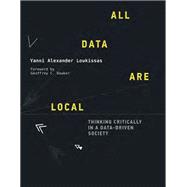
- ISBN: 9780262545174 | 0262545179
- Cover: Paperback
- Copyright: 5/3/2022
How to analyze data settings rather than data sets, acknowledging the meaning-making power of the local.
In our data-driven society, it is too easy to assume the transparency of data. Instead, Yanni Loukissas argues in All Data Are Local, we should approach data sets with an awareness that data are created by humans and their dutiful machines, at a time, in a place, with the instruments at hand, for audiences that are conditioned to receive them. The term data set implies something discrete, complete, and portable, but it is none of those things. Examining a series of data sources important for understanding the state of public life in the United States—Harvard's Arnold Arboretum, the Digital Public Library of America, UCLA's Television News Archive, and the real estate marketplace Zillow—Loukissas shows us how to analyze data settings rather than data sets.
Loukissas sets out six principles: all data are local; data have complex attachments to place; data are collected from heterogeneous sources; data and algorithms are inextricably entangled; interfaces recontextualize data; and data are indexes to local knowledge. He then provides a set of practical guidelines to follow. To make his argument, Loukissas employs a combination of qualitative research on data cultures and exploratory data visualizations. Rebutting the “myth of digital universalism,” Loukissas reminds us of the meaning-making power of the local.
In our data-driven society, it is too easy to assume the transparency of data. Instead, Yanni Loukissas argues in All Data Are Local, we should approach data sets with an awareness that data are created by humans and their dutiful machines, at a time, in a place, with the instruments at hand, for audiences that are conditioned to receive them. The term data set implies something discrete, complete, and portable, but it is none of those things. Examining a series of data sources important for understanding the state of public life in the United States—Harvard's Arnold Arboretum, the Digital Public Library of America, UCLA's Television News Archive, and the real estate marketplace Zillow—Loukissas shows us how to analyze data settings rather than data sets.
Loukissas sets out six principles: all data are local; data have complex attachments to place; data are collected from heterogeneous sources; data and algorithms are inextricably entangled; interfaces recontextualize data; and data are indexes to local knowledge. He then provides a set of practical guidelines to follow. To make his argument, Loukissas employs a combination of qualitative research on data cultures and exploratory data visualizations. Rebutting the “myth of digital universalism,” Loukissas reminds us of the meaning-making power of the local.

Please wait while the item is added to your bag...



Review