
Art and Craft of College Teaching : A Guide for New Professors and Graduate Students
, by Rotenberg,Robert- ISBN: 9781598745344 | 1598745344
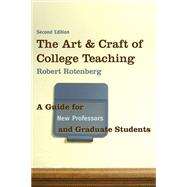
- Cover: Nonspecific Binding
- Copyright: 5/15/2010
| Preface | p. 11 |
| Teaching as an Art and Teaching as a Craft | p. 15 |
| The Learning Curve of the College Teacher | p. 18 |
| Plan of the Book | p. 21 |
| What Do We Know About Postsecondary Intellectual Development? | p. 26 |
| Bloom and Perry on Adult Learners | p. 27 |
| Kolb and Experiential Learning | p. 29 |
| Gardner and Multiple Intelligences | p. 30 |
| Baxter-Magolda and Ways of Knowing | p. 31 |
| King and Kitchener and the Reflective Judgment Model | p. 32 |
| What Do We Know About Effective Undergraduate Teaching? | p. 35 |
| Current Approaches to Understanding Growth in Thinking Skills | p. 36 |
| History and Development of Best Practices Research | p. 41 |
| The Role of the Teacher in the Classroom | p. 47 |
| The Real Relationship Between Teacher and Student | p. 48 |
| Figuring Out What to Teach and How Much of It | p. 54 |
| Who Are Our Students? | p. 57 |
| The Virtual Classroom and Hybrid Learning Spaces | p. 65 |
| Demands on the New Instructor | p. 67 |
| Departmental Demands | p. 68 |
| Demands of General Education Courses | p. 70 |
| Demands of the Undergraduate Major | p. 73 |
| Demands of Graduate Programs | p. 75 |
| Interdisciplinary Demands | p. 77 |
| Universal Design | p. 83 |
| Universal Design in Higher Education | p. 19 |
| Universal Design of Courses | p. 86 |
| Constructing the Syllabus | p. 88 |
| Developing a Course for the First Time | p. 90 |
| The Impact of Class Size on a Syllabus | p. 97 |
| Taking the Calendar into Account | p. 102 |
| Ordering Books and Photocopying Material | p. 104 |
| Technical Components of a Syllabus | p. 110 |
| Selecting the Knowledge Base for the Course | p. 113 |
| Selecting Texts | p. 114 |
| Fitting the Course into the Curriculum | p. 116 |
| Organizing the Course around Problem Sets | p. 117 |
| Organizing the Course around Specific Experiences | p. 119 |
| Learning Management Software | p. 120 |
| Setting Your Expectations for Students' Reasoning Skills | p. 123 |
| Characterizing Critical Thinking | p. 125 |
| How to Recognize Critical Thinking | p. 126 |
| Setting Your Expectations for Creativity | p. 131 |
| The Cognitive Basis for Creative Thinking | p. 132 |
| How Do You Recognize Creativity When It Occurs? | p. 133 |
| Supporting the Creative Process | p. 135 |
| Assessing Student Learning | p. 39 |
| Best Practices in Student Assessment | p. 141 |
| Tools for Classroom-Level Assessment | p. 143 |
| Assessment Essays | p. 145 |
| Group Assessment | p. 146 |
| Portfolio Assessment | p. 147 |
| The Lecture Classroom | p. 149 |
| What Is a Lecture? | p. 149 |
| Tools for More Effective Lectures | p. 151 |
| What Lecture Formats Can and Cannot Do | p. 155 |
| The Living Textbook Approach | p. 156 |
| Developing an Active Lecture Format | p. 157 |
| Techniques for Livelier Lecture Classes | p. 159 |
| Helping Students Listen Effectively to Lectures | p. 160 |
| Working with Teaching Assistants | p. 163 |
| The Discussion Classroom | p. 166 |
| Discussion Techniques | p. 168 |
| Making It Difficult for the Students to Be Unprepared | p. 179 |
| Motivational Issues in Discussions | p. 181 |
| Dealing with Silence | p. 182 |
| Dealing with Talkers | p. 184 |
| Student-Generated Discussion | p. 185 |
| Designing a Discussion around Specific Roles | p. 186 |
| First Aid for Tired Discussions | p. 187 |
| Discussions of Controversial Subjects | p. 188 |
| The Socratic Form of Discussion | p. 195 |
| Non-Socratic Forms of Discussion | p. 197 |
| Assessing Discussion Outcomes | p. 203 |
| The Seminar Classroom | p. 207 |
| Strategies for Organizing a Seminar | p. 210 |
| The Seminar Process | p. 212 |
| Evaluating Seminar Performance | p. 214 |
| The Laboratory Classroom | p. 216 |
| Collaborative Learning in the Laboratory? | p. 219 |
| Teaching Strategies for Laboratories | p. 220 |
| Teaching Reasoning Skills in the Laboratory | p. 221 |
| Collaborative Learning in Problem-Based Classrooms | p. 223 |
| Strategies for Problem-Based Learning in the Laboratory | p. 226 |
| Applying Problem-Based Learning in the Classroom | p. 228 |
| Assigning Literature in Problem-Based Learning | p. 231 |
| Framing the Students' Learning in Problem-Based Learning | p. 232 |
| Tutoring Group Process in Problem-Based Learning | p. 238 |
| Managing Team and Group Research Dynamics | p. 240 |
| Forming Work Groups in a Collaborative Classroom | p. 244 |
| Dealing with Student Complaints in Group Research | p. 249 |
| Case-Based Learning Methods | p. 251 |
| Designing a Case-Based Course | p. 252 |
| How to Teach a Case Laboratory | p. 253 |
| Simulation and Games | p. 255 |
| Film, Video, and Audio Case Materials | p. 257 |
| Fieldwork, Internships, and Service and Experiential Learning | p. 258 |
| Field-Based Learning | p. 260 |
| Teaching in the Field | p. 262 |
| Evaluating Field-Based Learning | p. 264 |
| Writing Field-Based and Laboratory Reports | p. 265 |
| Evaluating Collaborative Learning | p. 267 |
| The On-Line Classroom | p. 270 |
| Instructor's Considerations for Distance Learning | p. 271 |
| Student Readiness for Distance Learning | p. 275 |
| Structuring Time on Task in Distance Learning | p. 276 |
| Communication Issues in Distance Learning | p. 276 |
| Incorporating Social Media in Learning Environments | p. 280 |
| Advising in the Classroom | p. 285 |
| Diffusing Career Anxiety | p. 287 |
| Degree Progress Issues in an Era of Restricted Budgets | p. 288 |
| Supporting Time Management | p. 289 |
| Understanding Learning Disabilities | p. 291 |
| Helping Students with Life Crisis Issues | p. 293 |
| Helping Underachieving Students | p. 294 |
| Dealing with Angry, Aggressive, or Bullying Students | p. 296 |
| Dealing with Flattery | p. 298 |
| Dealing with Emotional Reactions to Sensitive Topics | p. 299 |
| Effective Evaluation of Student Achievement | p. 302 |
| Establishing Fair and Effective Grading Policies | p. 304 |
| Grading Practices to Avoid | p. 309 |
| Combating Grade Inflation | p. 311 |
| Criterion-Based Grading | p. 313 |
| Asking Appropriate Questions for Evaluation | p. 318 |
| The Test | p. 324 |
| Timed vs. Untimed Tests | p. 325 |
| Partial vs. Comprehensive Testing | p. 326 |
| Oral vs. Written Exams | p. 328 |
| The Presentation | p. 330 |
| The Essay | p. 333 |
| The Research Project | p. 336 |
| The Group Writing Project | p. 339 |
| Evaluating Group Work | p. 340 |
| Administrative Issues in the Classroom | p. 342 |
| Academic Integrity | p. 342 |
| Student Contractual Issues | p. 350 |
| Independent Studies | p. 356 |
| Makeup Policies and Exams | p. 359 |
| Grade Challenges | p. 359 |
| Evaluating the Instructor | p. 362 |
| Student-Based Evaluation | p. 363 |
| What to Do About "Bad" Evaluations | p. 368 |
| Peer-Based Evaluation | p. 370 |
| A Final Word | p. 373 |
| Web Resources | p. 375 |
| References | p. 379 |
| About the Author | p. 399 |
| Table of Contents provided by Ingram. All Rights Reserved. |
The New copy of this book will include any supplemental materials advertised. Please check the title of the book to determine if it should include any access cards, study guides, lab manuals, CDs, etc.
The Used, Rental and eBook copies of this book are not guaranteed to include any supplemental materials. Typically, only the book itself is included. This is true even if the title states it includes any access cards, study guides, lab manuals, CDs, etc.
Flag Review
Digital License
You are licensing a digital product for a set duration. Durations are set forth in the product description, with "Lifetime" typically meaning five (5) years of online access and permanent download to a supported device. All licenses are non-transferable.
More details can be found here.



