
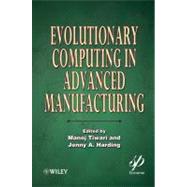
- ISBN: 9780470639245 | 0470639245
- Cover: Hardcover
- Copyright: 7/5/2011
| Preface | p. xiii |
| List of Contributors | p. xvii |
| Production Planning Using Genetic Algorithm | p. 1 |
| Introduction | p. 1 |
| Production Planning Models | p. 2 |
| Mathematical Model | p. 3 |
| Genetic Algorithm | p. 9 |
| Procedure of Genetic Algorithm (GA) | p. 10 |
| Implementation of GA | p. 15 |
| Parameter Tuning | p. 16 |
| Summary | p. 18 |
| Further Reading | p. 18 |
| Process Planning through Ant Colony Optimization | p. 19 |
| Introduction | p. 19 |
| Ant Colony Optimization (ACO) | p. 25 |
| Problem Description | p. 27 |
| Case Problem | p. 28 |
| Results | p. 31 |
| References | p. 33 |
| Introducing a Hybrid Genetic Algorithm for Integration of Set Up and Process Planning | p. 37 |
| Introduction | p. 38 |
| Process Planning | p. 38 |
| Machine Set-up Time | p. 39 |
| Optimization Methodology: Genetic Algorithms (GA) | p. 41 |
| Chromosome Representation | p. 43 |
| Fitness Value Evaluation | p. 44 |
| Selection Operation | p. 45 |
| Crossover Operations | p. 47 |
| Mutation Operations (k-opt exchange) | p. 47 |
| Conclusion | p. 48 |
| References | p. 48 |
| Design for Supply Chain with Product Development Issues Using Cellular Particle Swarm Optimization (CPSO) Technique | p. 51 |
| Introduction | p. 52 |
| Problem Formulation | p. 55 |
| Notations | p. 56 |
| Simulated Problem | p. 60 |
| Particle Swarm Algorithm (PSO) | p. 63 |
| Cellular Particle Swarm Optimization (CPSO) Algorithm | p. 67 |
| CPSO-outer Algorithm | p. 69 |
| Computational Analysis and Result | p. 71 |
| Conclusions | p. 74 |
| References | p. 75 |
| Genetic Algorithms with Chromosome Differentiation (GACD) Based Approach for Process Plan Selection Problems | p. 77 |
| Introduction | p. 77 |
| Problem Formulation | p. 80 |
| Genetic Algorithm with Chromosome Differentiation | p. 81 |
| Overview of GA | p. 81 |
| Genetic Algorithm Incorporating Chromosome Differentiation | p. 82 |
| Description of GA with Chromosome Differentiation | p. 82 |
| GACD Based Solution Methodology to Process Plan Selection Problem | p. 86 |
| Selection of GACD's Parameter | p. 90 |
| Numerical Experiments | p. 90 |
| Conclusions | p. 92 |
| References | p. 92 |
| Operation Allocation in Flexible Manufacturing System Using Immune Algorithm | p. 95 |
| Introduction | p. 96 |
| Machine Loading Problem | p. 100 |
| Problem Formulation | p. 103 |
| Solution Methodology | p. 106 |
| Introduction to Immune System and Analogy to Immune Algorithm | p. 106 |
| Modified Immune Algorithm Used to Solve Machine Loading Problem (Prakash et al. 2008) | p. 108 |
| Fast Clonal Algorithm (Khilwani et al., 2008) | p. 113 |
| Implementing Immune Algorithm for Machine Loading Problem | p. 113 |
| Computational Result | p. 114 |
| Conclusion | p. 117 |
| References | p. 119 |
| Tool Selection in FMS A Hybrid SA-Tabu Algorithm Based Approach | p. 123 |
| Introduction | p. 124 |
| Literature Survey | p. 125 |
| Problem Formulation | p. 127 |
| Background on SA-Tabu Heuristic | p. 130 |
| Simulated Annealing | p. 130 |
| Tabu Search | p. 131 |
| Simulated Annealing-Tabu | p. 133 |
| Implementation of Tabu-Simulated Annealing | p. 133 |
| Notations Used in SA-Tabu Heuristic | p. 133 |
| Steps of the Hybrid SA-Tabu Heuristic | p. 134 |
| Representation | p. 135 |
| Search Parameters | p. 136 |
| Test Cases | p. 139 |
| Conclusion | p. 144 |
| References | p. 148 |
| Integrating AGVs and Production Planning with Memetic Particle Swarm Optimization | p. 151 |
| Introduction | p. 151 |
| Production and AGVs Scheduling | p. 153 |
| AGVs Routing | p. 154 |
| Literature Review | p. 154 |
| Mathematical Model | p. 155 |
| Problem Statement | p. 155 |
| Mathematical Programming Model | p. 155 |
| PSO and EMPSO | p. 159 |
| Example | p. 161 |
| Recombination (Local Search) | p. 163 |
| Summary | p. 166 |
| References | p. 166 |
| Simulation-Based Aircraft Assembly Planning Using a Self-Guided Ant Colony Algorithm | p. 169 |
| Introduction | p. 170 |
| Background and Literature Survey | p. 172 |
| Assembly Planning in Aircraft Manufacturing | p. 172 |
| Self-Guided Ant Colony Algorithm | p. 176 |
| Specifications of the Considered Aircraft Assembly | p. 177 |
| Proposed Simulation-Based Assembly Planning Framework | p. 179 |
| Overview of the Proposed Framework | p. 179 |
| Mathematical Formulation | p. 183 |
| Details of Self Guided Ant Colony Algorithm (SGAC) | p. 184 |
| Experiment and Results | p. 189 |
| Effect of Rework on the Total Lead Time | p. 191 |
| Effect of Size of the Order on the Average Utilization of Workstations | p. 192 |
| Conclusion and Future Work | p. 192 |
| References | p. 193 |
| Applications of Evolutionary Computing to Additive Manufacturing | p. 197 |
| Introduction | p. 198 |
| Design for Additive Manufacturing | p. 200 |
| Structural-Design | p. 200 |
| Functional Grading | p. 203 |
| Digital Design/Art | p. 205 |
| Inspired by Nature | p. 208 |
| Future Challenges | p. 210 |
| Data Handling | p. 212 |
| Process Planning | p. 216 |
| Build Packing | p. 216 |
| Part Orientation | p. 223 |
| Slicing | p. 226 |
| Parameter Optimisation | p. 229 |
| Summary | p. 231 |
| Concluding Remarks | p. 232 |
| References | p. 232 |
| Multiple Fault Diagnosis Using Psycho-Clonal Algorithms | p. 235 |
| Introduction | p. 235 |
| Multiple Fault Diagnosis Problems | p. 237 |
| Background of Psychoclonal Algorithm | p. 242 |
| Artificial Immune System (AIS) | p. 242 |
| Theory of Clonal Selection | p. 244 |
| Maslow's Need Hierarchy Theory | p. 246 |
| Pseudo Code for Psycho Clonal Algorithm | p. 248 |
| Numerical Experiments | p. 250 |
| Test Problems | p. 250 |
| Results and Discussions | p. 252 |
| Conclusion | p. 254 |
| References | p. 257 |
| Platform Formation Under Stochastic Demand | p. 259 |
| Introduction | p. 259 |
| Background | p. 261 |
| Problem Description | p. 263 |
| Problem Statement | p. 264 |
| Formulation of the Model | p. 265 |
| Evolutionary Solution Approaches | p. 268 |
| Solution Encoding | p. 269 |
| Genetic Algorithm with Integer Programming (GAIP) | p. 269 |
| Pure Probability Based Heuristic Approach | p. 271 |
| Extension to Independent Demand for Each Product | p. 272 |
| Example Problem - Results and Discussions | p. 272 |
| Example | p. 272 |
| Results and Discussions | p. 273 |
| Results and Analysis Using GAIP | p. 273 |
| The Solution Quality of PHA and Comparison with the GAIP Approach | p. 275 |
| Results When Demand of Each Product is Represented as a Probability Distribution | p. 280 |
| Conclusion and Recommendations for Future Research | p. 283 |
| References | p. 285 |
| A Hybrid Particle Swarm and Ant Colony Optimizer for Multi-attribute Partnership Selection in Virtual Enterprises | p. 289 |
| Introduction | p. 289 |
| Literature Review | p. 292 |
| Partner Selection Problem Formation | p. 294 |
| Fundamental Variables Discussion | p. 294 |
| Partner Selection Problem Description | p. 295 |
| Solution Methodology | p. 297 |
| Particle Swarm Optimization | p. 297 |
| Ant Colony Optimization | p. 299 |
| Hybrid PSO-ACO | p. 300 |
| Weights of the Criteria and the Qualitative Variables | p. 303 |
| Experimental Analysis | p. 308 |
| Determine the Weights of the Main Criteria and Sub-Criteria | p. 309 |
| Evaluation of Qualitative Attributes | p. 313 |
| Evaluation of the Quantitative Aspects of the Enterprise | p. 316 |
| Results | p. 316 |
| Conclusion | p. 319 |
| Nomenclature | p. 320 |
| References | p. 324 |
| Index | p. 327 |
| Table of Contents provided by Ingram. All Rights Reserved. |
The New copy of this book will include any supplemental materials advertised. Please check the title of the book to determine if it should include any access cards, study guides, lab manuals, CDs, etc.
The Used, Rental and eBook copies of this book are not guaranteed to include any supplemental materials. Typically, only the book itself is included. This is true even if the title states it includes any access cards, study guides, lab manuals, CDs, etc.
Flag Review
Digital License
You are licensing a digital product for a set duration. Durations are set forth in the product description, with "Lifetime" typically meaning five (5) years of online access and permanent download to a supported device. All licenses are non-transferable.
More details can be found here.



