

Facial Recognition Surveillance Policing and Human Rights in the Age of Artificial Intelligence
, by Fussey, Pete; Murray, Daragh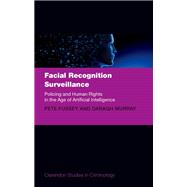
- ISBN: 9780192883704 | 0192883704
- Cover: Hardcover
- Copyright: 10/17/2025
Scanning millions of faces each year, facial recognition technology (FRT) has become one of today's fastest growing and most controversial AI-driven surveillance technologies.
Based on rare ethnographic access to police FRT deployments, Facial Recognition Surveillance: Policing and Human Rights in the Age of Artificial Intelligence delves into the profound impact of FRT on policing practices, surveillance capabilities, and human rights protections. It reveals how this technology shapes, and is also shaped by, the complex environments in which it is deployed, dramatically reshaping police-citizen interactions.
This book exposes the selective scientific and legal narratives that justify the expansion of AI-driven surveillance. It draws on cutting-edge human rights theory to propose a due diligence framework tailored to police use of FRT and introduces the concept of 'compound human rights harm' to capture the multifaceted impact of surveillance.
Integrating insights from the sociology of policing, science and technology studies, and human rights scholarship, this book advances a theoretically novel and empirically informed perspective that positions FRT as a socio-technical system capable of altering the fundamental nature of policing.
Based on rare ethnographic access to police FRT deployments, Facial Recognition Surveillance: Policing and Human Rights in the Age of Artificial Intelligence delves into the profound impact of FRT on policing practices, surveillance capabilities, and human rights protections. It reveals how this technology shapes, and is also shaped by, the complex environments in which it is deployed, dramatically reshaping police-citizen interactions.
This book exposes the selective scientific and legal narratives that justify the expansion of AI-driven surveillance. It draws on cutting-edge human rights theory to propose a due diligence framework tailored to police use of FRT and introduces the concept of 'compound human rights harm' to capture the multifaceted impact of surveillance.
Integrating insights from the sociology of policing, science and technology studies, and human rights scholarship, this book advances a theoretically novel and empirically informed perspective that positions FRT as a socio-technical system capable of altering the fundamental nature of policing.

Please wait while the item is added to your bag...



Review