

Heir through Hope Thomas Jefferson's Lifelong Investment in William Short
, by Thompson, Peter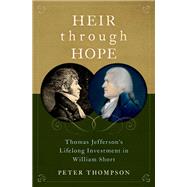
- ISBN: 9780197546833 | 0197546838
- Cover: Hardcover
- Copyright: 10/6/2023
The relationship between Thomas Jefferson and William Short, the eldest son of an established Virginia family and relative of Martha Jefferson, began as a patron-protégé arrangement conventional for the era. Jefferson encouraged Short's legal career and gave him his first legal work. Thus began a bond of forty years that that both men characterized in paternal and filial terms and that sheds considerable light on the enigmatic Founding Father.
In the aftermath of Jefferson's precipitous "flight from Monticello," Short underwrote substantial short-term loans to him. Jefferson took the younger man to France as his private secretary in 1784 but, quickly concluding that his moral well-being and political judgment were at risk, he urged Short to return to America and settle down. Short, however, wished to pursue a foreign service career and a long affair with a French aristocrat. Jefferson wanted Short to embrace a Virginia way of looking at the world, even buying him a farm near Monticello. Short resisted--and rejected Jefferson's ideas about slavery, economics, marriage, the practice of democratic government, and republican morality, but without rejecting his "friend and father." He showed little respect for Jefferson's political achievements, viewing him as a well-meaning "visionary," yet he was conscious of living in the statesman's shadow. William Short was not Thomas Jefferson's intellectual equal, was not a political collaborator, and never became a neighbor, yet the elder man invested considerable emotional energy and time in his "adoptive son," even during his vice-presidency and presidency. By efficiently managing the younger man's financial affairs Jefferson enabled his extended stay in France, but also diverted Short's money for his own use. Although he believed Short's political judgment had been clouded by his enjoyment of French society and savagely criticized his reaction to the French Revolution, he never gave up on Short the private individual.
Heir through Hope reveals a figure who served as a unique sounding board to a Founder, while underscoring the distinct ways Jefferson envisioned the United States' destiny vis à vis Europe. Fascinating in its own right, their complex relationship highlights the tensions between the founding generation and its successors while illuminating the operation of political power in early national America and Revolutionary Europe.
In the aftermath of Jefferson's precipitous "flight from Monticello," Short underwrote substantial short-term loans to him. Jefferson took the younger man to France as his private secretary in 1784 but, quickly concluding that his moral well-being and political judgment were at risk, he urged Short to return to America and settle down. Short, however, wished to pursue a foreign service career and a long affair with a French aristocrat. Jefferson wanted Short to embrace a Virginia way of looking at the world, even buying him a farm near Monticello. Short resisted--and rejected Jefferson's ideas about slavery, economics, marriage, the practice of democratic government, and republican morality, but without rejecting his "friend and father." He showed little respect for Jefferson's political achievements, viewing him as a well-meaning "visionary," yet he was conscious of living in the statesman's shadow. William Short was not Thomas Jefferson's intellectual equal, was not a political collaborator, and never became a neighbor, yet the elder man invested considerable emotional energy and time in his "adoptive son," even during his vice-presidency and presidency. By efficiently managing the younger man's financial affairs Jefferson enabled his extended stay in France, but also diverted Short's money for his own use. Although he believed Short's political judgment had been clouded by his enjoyment of French society and savagely criticized his reaction to the French Revolution, he never gave up on Short the private individual.
Heir through Hope reveals a figure who served as a unique sounding board to a Founder, while underscoring the distinct ways Jefferson envisioned the United States' destiny vis à vis Europe. Fascinating in its own right, their complex relationship highlights the tensions between the founding generation and its successors while illuminating the operation of political power in early national America and Revolutionary Europe.

Please wait while the item is added to your bag...



Review