

Lectures on Microeconomics The Big Questions Approach
, by Pancs, Romans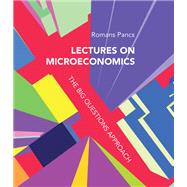
- ISBN: 9780262552899 | 0262552892
- Cover: Paperback
- Copyright: 8/20/2024
Economic concepts and techniques presented through a series of "big questions," models that show how to pose a questions rigorously and work toward an answer.
This book helps readers master economic concepts and techniques by tackling fundamental economic and political questions through a series of models. It is organized around a sequence of “big questions,” among them: When do markets help translate individuals' uncoordinated, selfish actions into outcomes that are best for all? Do markets change people, and, if so, for worse or better? Translated into the language of modern economics, do Marx's ideas have merit? Why is there so much income inequality? Or is there too little? The arguments are in the theorem-proof format, distinguishing results derived in the context of fully specified models from educated speculation. Readers will learn how to pose a question rigorously and how to work toward an answer, and to appreciate that even (especially!) the broadest and most ambitious questions call for a model. The goal of the book is not to indoctrinate but to show readers how to reason toward their own conclusions.
The first chapter, on the Walrasian model of general equilibrium, serves as the prerequisite for the rest of the book. The remaining chapters cover less conventional topics, including the morality of markets; matching theory; Marxism, socialism, and the resilience of markets; a formalization of Kant's categorical imperative; unintended consequences of policy design; and theories of justice. The book can be used as a textbook for advanced undergraduate or graduate students or as a resource for researchers in disciplines that draw on normative economics.
This book helps readers master economic concepts and techniques by tackling fundamental economic and political questions through a series of models. It is organized around a sequence of “big questions,” among them: When do markets help translate individuals' uncoordinated, selfish actions into outcomes that are best for all? Do markets change people, and, if so, for worse or better? Translated into the language of modern economics, do Marx's ideas have merit? Why is there so much income inequality? Or is there too little? The arguments are in the theorem-proof format, distinguishing results derived in the context of fully specified models from educated speculation. Readers will learn how to pose a question rigorously and how to work toward an answer, and to appreciate that even (especially!) the broadest and most ambitious questions call for a model. The goal of the book is not to indoctrinate but to show readers how to reason toward their own conclusions.
The first chapter, on the Walrasian model of general equilibrium, serves as the prerequisite for the rest of the book. The remaining chapters cover less conventional topics, including the morality of markets; matching theory; Marxism, socialism, and the resilience of markets; a formalization of Kant's categorical imperative; unintended consequences of policy design; and theories of justice. The book can be used as a textbook for advanced undergraduate or graduate students or as a resource for researchers in disciplines that draw on normative economics.

Please wait while the item is added to your bag...



Review