

Making Wicked Problems Governable? The Continuing Case of Managed Networks in Health Care
, by Ferlie, Ewan; FitzGerald, Louise; McGivern, Gerry; Dopson, Sue; Bennett, Chris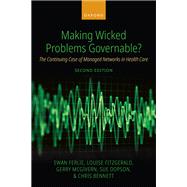
- ISBN: 9780198936237 | 0198936230
- Cover: Paperback
- Copyright: 9/4/2025
Making Wicked Problems Governable? analyzes managed networks established to enhance service delivery within complex, cross-cutting sectors-a cornerstone of the health management reforms pursued by the UK New Labour governments (1997-2010). Drawing on extensive case study data, the revised second edition features a substantially expanded introduction and updated chapters, underscoring its enduring relevance to contemporary Labour government policies and the persistent challenges in health and social care. The book makes three key contributions.
The first relates to Network Governance in Practice: It demonstrates that New Labour's reforms were profoundly influenced by Network Governance principles, fundamentally reshaping the structure and delivery of health care services.
The second concerns 'Addressing 'Wicked Problems': By integrating the concept of 'wicked problems,' the work explores policy areas where network-based governance may offer a more effective alternative to traditional market mechanisms or hierarchical models. It compellingly argues that wicked problems are pervasive in health policy and thus merit serious consideration as an analytical framework.
The third involves a Governmentality Perspective: Employing a governmentality framework, the book provides a fresh theoretical lens for understanding the indirect modes of public service governance, enriching debates on how best to manage complex policy challenges.
Ideal for both policy makers and academic readers, Making Wicked Problems Governable? offers critical insights into the transformation of health care governance and presents robust frameworks for addressing some of today's most intractable public policy issues.'
The first relates to Network Governance in Practice: It demonstrates that New Labour's reforms were profoundly influenced by Network Governance principles, fundamentally reshaping the structure and delivery of health care services.
The second concerns 'Addressing 'Wicked Problems': By integrating the concept of 'wicked problems,' the work explores policy areas where network-based governance may offer a more effective alternative to traditional market mechanisms or hierarchical models. It compellingly argues that wicked problems are pervasive in health policy and thus merit serious consideration as an analytical framework.
The third involves a Governmentality Perspective: Employing a governmentality framework, the book provides a fresh theoretical lens for understanding the indirect modes of public service governance, enriching debates on how best to manage complex policy challenges.
Ideal for both policy makers and academic readers, Making Wicked Problems Governable? offers critical insights into the transformation of health care governance and presents robust frameworks for addressing some of today's most intractable public policy issues.'

Please wait while the item is added to your bag...



Review