

Mary Shepherd A Guide
, by Boyle, Deborah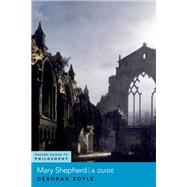
- ISBN: 9780190090333 | 0190090332
- Cover: Paperback
- Copyright: 1/3/2023
Scottish philosopher Lady Mary Shepherd (1777-1847) wrote two books that she conceived as one unified project: Essay Upon the Relation of Cause and Effect (1824) and Essays on the Perception of an External Universe (1827). While they were well received in her day, Shepherd's insightful philosophical writings have been neglected for some 150 years and are only now receiving the scholarly attention they deserve. Mary Shepherd: A Guide by Deborah Boyle, part of the Oxford Guides to Philosophy series, navigates students of philosophy or general readers through Shepherd's two significant works.
The first four chapters address topics raised in the 1824 Essay: Shepherd's arguments for two key causal principles, her objections to Hume and her alternative accounts of causation and causal inference; her theory of objects as bundles of qualities; her critique of Thomas Brown's defence of Humean causation; and her discussion of London surgeon William Lawrence's accounts of sentience and life, which Shepherd treats as a case study of how Humean theory can lead to errors in scientific reasoning. Chapter 5 covers topics central to both of Shepherd's books: what she means by "sensation," "idea," "will," "imagination," "understanding," "reasoning," and "latent reasoning." The remaining five chapters proceed systematically through Shepherd's 1827 book, where she seeks to prove, against Berkeleian idealism, that we can know that an external world of mind-independent matter exists. Boyle discusses Shepherd's proofs for such an external world, her responses to various sceptical challenges, and her specific objections to Berkeley. Each chapter ends with a list of works for further reading and a glossary of terms that explain Shepherd's sometimes idiosyncratic philosophical vocabulary, resulting in an essential guide to a philosopher who exerted considerable influence during her time.
The first four chapters address topics raised in the 1824 Essay: Shepherd's arguments for two key causal principles, her objections to Hume and her alternative accounts of causation and causal inference; her theory of objects as bundles of qualities; her critique of Thomas Brown's defence of Humean causation; and her discussion of London surgeon William Lawrence's accounts of sentience and life, which Shepherd treats as a case study of how Humean theory can lead to errors in scientific reasoning. Chapter 5 covers topics central to both of Shepherd's books: what she means by "sensation," "idea," "will," "imagination," "understanding," "reasoning," and "latent reasoning." The remaining five chapters proceed systematically through Shepherd's 1827 book, where she seeks to prove, against Berkeleian idealism, that we can know that an external world of mind-independent matter exists. Boyle discusses Shepherd's proofs for such an external world, her responses to various sceptical challenges, and her specific objections to Berkeley. Each chapter ends with a list of works for further reading and a glossary of terms that explain Shepherd's sometimes idiosyncratic philosophical vocabulary, resulting in an essential guide to a philosopher who exerted considerable influence during her time.

Please wait while the item is added to your bag...



Review