

Money, Politics, and the First Amendment Fifty Years of Supreme Court Decisions and Campaign Finance Reforms
, by Bollinger, Lee C.; Stone, Geoffrey R.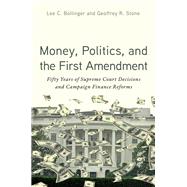
- ISBN: 9780197821916 | 019782191X
- Cover: Paperback
- Copyright: 3/20/2026
Money in political campaigns is a subject of endless current interest and enormous consequence for American democracy. Beginning in 1976, in Buckley v. Valeo, the Supreme Court established a framework for public campaign regulation that declared that money constitutes "speech" and that the only constitutional basis upon which the government can regulate money was to prohibit corruption or the appearance of corruption. The Court then defined corruption narrowly and held that direct "contributions" to candidates could be limited on that basis but that "expenditures," by political candidates and others, could not. Over time as the role of money became more and more serious in politics the Court in a number of decisions seemed to be turning more willing to accept regulation. But in Citizens United v. Federal Election Commission, the new conservative Supreme Court sharply turned against permitting regulation, including of corporations.
Today that regime of nearly full protection for anyone spending virtually any amount of money for or against candidates and issues remains securely in place. The question, after a half century of this system, is whether this interpretation of the First Amendment is sound or not. If yes, then what are the justifications and what will be the consequences? If not, then what are alternative interpretations and what would the world be like under each one? The contributors, all scholars and experts in this area, give their interpretations and proposals.
Today that regime of nearly full protection for anyone spending virtually any amount of money for or against candidates and issues remains securely in place. The question, after a half century of this system, is whether this interpretation of the First Amendment is sound or not. If yes, then what are the justifications and what will be the consequences? If not, then what are alternative interpretations and what would the world be like under each one? The contributors, all scholars and experts in this area, give their interpretations and proposals.

Please wait while the item is added to your bag...



Review