

Philo of Alexandria and the Construction of Jewishness in Early Christian Writings
, by Otto, Jennifer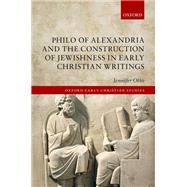
- ISBN: 9780198820727 | 0198820720
- Cover: Hardcover
- Copyright: 7/24/2018
Philo of Alexandria and the Construction of Jewishness in Early Christian Writings investigates portrayals of the first-century philosopher and exegete Philo of Alexandria, in the writings of Clement of Alexandria, Origen, and Eusebius. It argues that early Christian invocations of Philo are best understood not as attempts simply to claim an illustrious Jew for the Christian fold, but as examples of ongoing efforts to define the continuities and distinctive features of Christian beliefs and practices in relation to those of the Jews.
This study takes as its starting point the curious fact that none of the first three Christians to mention Philo refer to him unambiguously as a Jew. Clement, the first in the Christian tradition to openly cite Philo's works, refers to him twice as a Pythagorean. Origen, who mentions Philo by name only three times, makes far more frequent reference to him in the guise of an anonymous "one who came before us." Eusebius, who invokes Philo on many more occasions than does Clement or Origen, most often refers to Philo as a Hebrew. These epithets construct Philo as an alternative "near-other" to both Christians and Jews, through whom ideas and practices may be imported to the former from the latter, all the while establishing boundaries between the "Christian" and "Jewish" ways of life. The portraits of Philo offered by each author reveal ongoing processes of difference-making and difference-effacing that constituted not only the construction of the Jewish "other," but also the Christian "self."
This study takes as its starting point the curious fact that none of the first three Christians to mention Philo refer to him unambiguously as a Jew. Clement, the first in the Christian tradition to openly cite Philo's works, refers to him twice as a Pythagorean. Origen, who mentions Philo by name only three times, makes far more frequent reference to him in the guise of an anonymous "one who came before us." Eusebius, who invokes Philo on many more occasions than does Clement or Origen, most often refers to Philo as a Hebrew. These epithets construct Philo as an alternative "near-other" to both Christians and Jews, through whom ideas and practices may be imported to the former from the latter, all the while establishing boundaries between the "Christian" and "Jewish" ways of life. The portraits of Philo offered by each author reveal ongoing processes of difference-making and difference-effacing that constituted not only the construction of the Jewish "other," but also the Christian "self."

Please wait while the item is added to your bag...



Review