

The Quality of Life Aristotle Revised
, by Kraut, Richard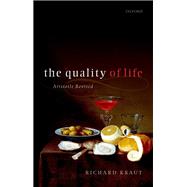
- ISBN: 9780198868729 | 0198868723
- Cover: Paperback
- Copyright: 1/26/2021
The Quality of Life: Aristotle Revised presents a philosophical theory about the constituents of human well-being. The principal idea is that what Aristotle calls 'external goods' - wealth, reputation, power - have at most an indirect bearing on the quality of our lives. Starting with Aristotle's thoughts about this topic, Kraut increasingly modifies (and occasionally rejects) that stance. He argues that the way in which we experience the world is what well-being consists in. A good internal life comprises, in part, pleasure but far more valuable is the quality of our emotional, intellectual, social, and perceptual experiences. These offer the potential for a richer and deeper quality of life than that which is available to many other animals.
A good human life is immeasurably better than that of a simple creature that feels only the pleasures of nourishment; even if it felt pleasure for millions of years, human life would be superior. In opposition to contemporary discussions of well-being, which often appeal to a thought experiment devised by Robert Nozick, Kraut concludes that the quality of our lives consists entirely in the quality of our experiences. While others hold that we must live in 'the real world' to live well and that one's interior life has little or no value on its own, Kraut's interpretation of this thought experiment supports the opposite conclusion.
A good human life is immeasurably better than that of a simple creature that feels only the pleasures of nourishment; even if it felt pleasure for millions of years, human life would be superior. In opposition to contemporary discussions of well-being, which often appeal to a thought experiment devised by Robert Nozick, Kraut concludes that the quality of our lives consists entirely in the quality of our experiences. While others hold that we must live in 'the real world' to live well and that one's interior life has little or no value on its own, Kraut's interpretation of this thought experiment supports the opposite conclusion.

Please wait while the item is added to your bag...



Review