

- ISBN: 9780691026978 | 0691026971
- Cover: Paperback
- Copyright: 7/19/1999
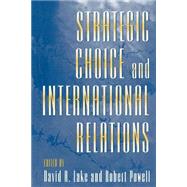
The strategic-choice approach has a long pedigree in international relations. In an area often rent by competing methodologies, editors David A. Lake and Robert Powell take the best of accepted and contested knowledge among many theories. With the contributors to this volume, they offer a unifying perspective, which begins with a simple insight: students of international relations want to explain the choices actors make--whether these actors be states, parties, ethnic groups, companies, leaders, or individuals. This synthesis offers three new benefits: first, the strategic interaction of actors is the unit of analysis, rather than particular states or policies; second, these interactions are now usefully organized into analytic schemes, on which conceptual experiments may be based; and third, a set of methodological "bets" is then made about the most productive ways to analyze the interactions. Together, these elements allow the pragmatic application of theories that may apply to a myriad of particular cases, such as individuals protesting environmental degradation, governments seeking to control nuclear weapons, or the United Nations attempting to mobilize member states for international peacekeeping. Besides the editors, the six contributors to this book, all distinguished scholars of international relations, are Jeffry A. Frieden, James D. Morrow, Ronald Rogowski, Peter Gourevitch, Miles Kahler, and Arthur A. Stein. Their work is an invaluable introduction for scholars and students of international relations, economists, and government decision-makers.

Please wait while the item is added to your bag...



Review