

Unafrican Americans
, by Adeleke, Tunde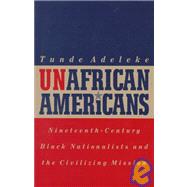
- ISBN: 9780813120560 | 081312056X
- Cover: Hardcover
- Copyright: 6/24/1998
" Though many scholars will acknowledge the Anglo-Saxon character of black American nationalism, few have dealt with the imperialistic ramifications of this connection. Now, Nigerian-born scholar Tunde Adeleke reexamines nineteenth-century black American nationalism, finding not only that it embodied the racist and paternalistic values of Euro-American culture but also that nationalism played an active role in justifying Europe's intrusion into Africa. Adeleke looks at the life and work of Martin Delany, Alexander Crummell, and Harry McNeal Turner, demonstrating that as supporters of the mission civilisatrice (""civilizing mission"") these men helped lay the foundation for the colonization of Africa. By exposing the imperialistic character of nineteenth-century black American nationalism, Adeleke reveals a deep historical and cultural divide between Africa and the black diaspora. Black American nationalists had a clear preference--Euro-America over Africa--and their plans were not designed for the immediate benefit of Africans but to enhance their own fortunes. Arguing that these men held a strong desire for cultural affinity with Europe, Adeleke makes a controversial addition to the ongoing debate concerning the roots of black nationalism and Pan-Africanism.

Please wait while the item is added to your bag...



Review